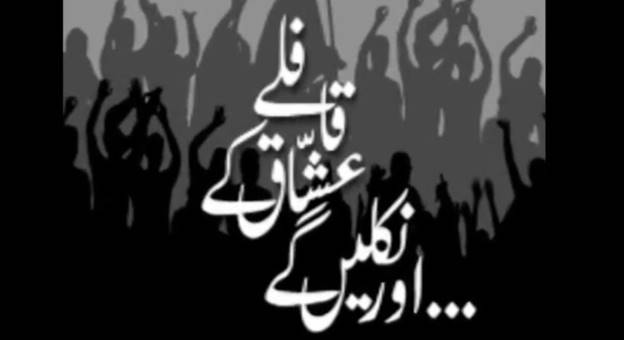
Poster for the documentary Aur Niklenge Ushhaq ke Qafley (There Will be More Caravans of Passion), 2010.
Lessons from the 1950s Democratic Students Federation movement remain relevant beyond Pakistan for the revived progressive consciousness of a new generation - Image by K.B. Abro
Reclaiming a Progressive Past: Documentary Screening in Boston Revisits an Iconic Student Movement in Pakistan
By Abdullah Zahid
Karachi, Pakistan
A recent screening in Boston of journalist and filmmaker Beena Sarwar’s documentary Aur Niklenge Ushhaq ke Qaaflay (There Will Be More Caravans of Passion) brought the 1950s Democratic Students Federation back into public memory, tracing its emergence as Pakistan’s first nation-wide student movement.
The documentary explores the formation and contribution of a hidden part of Pakistan’s history, a powerful movement led by the filmmaker’s father, the late Dr M Sarwar, while he was a student at Dow Medical College, Karachi, in the post-Partition years.
At the hybrid post-screening discussion held at the Community Church of Boston in the city’s historic Copley Square, participants reflected on how the movement mobilised thousands of young people around collective political action.
The event, titled “Resistance in Pakistan: Looking Back to Look Forward,” organised by the activist group Boston South Asian Coalition in collaboration with the Southasia Peace Action Network (Sapan) on 28 March, wasn’t just a documentary screening but a mini history lesson.
On 7 January 1953, a brutal police crackdown on the students’ peaceful ‘Demands Day’ demonstration in Karachi catapulted the movement into a nationwide one, as the late Dawn editor Saleem Asmi says in the film.
“This pattern continues to be repeated,” commented Beena Sarwar, joining online from Colombo, Sri Lanka.
She made the film in 2009 after Dr Sarwar passed away, in order to preserve a hidden part of Pakistan’s history. Her research on DSF taught her a lot, she said, like the importance of organising around a minimum common agenda and shared vision, besides approaching the community for funds, ideas that underlie Sapan, which she cofounded in 2021.
The post-screening discussion featured Lahore-based economist Dr Taimur Rahman who is also lead singer and guitarist of the music band Laal (Red) that he founded in 2008. The band had performed at the documentary’s premiere at the Karachi Arts Council in January 2010.
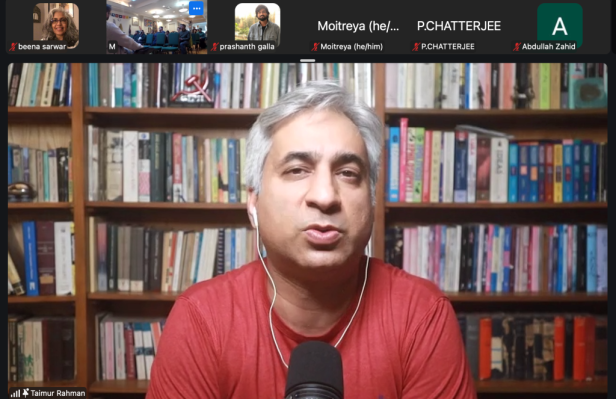
Dr Taimur Rahman addressing the hybrid audience at the event organised in Boston by BSAC in collaboration with Sapan - Screenshot
Rahman’s eye-opening sketch of Pakistan’s leftist trajectory , from its rise to its suppression and its gradual boom into new life, put the documentary in a broader context.
“Today, you think of Pakistan perhaps as being a very conservative society in which there isn’t really a very, or never has really been a strong left or progressive tradition,” said Rahman, who teaches political science at Lahore University of Management Sciences.
“But what you’re witnessing in the 1950s here with Dr Sarwar and the DSF came at the climax also of a long struggle of anti-colonialism in which the communists of India had played a very key role,” he told participants.
The Communist Party of Pakistan became a central organising force – so much so that police records from the 1950s described it as “arguably the most well‑organised political party after the Muslim League,” said Rahman.
“The reason that was the case is not only because the party itself was substantive, but also because, through various organizations, the party exercised quite a remarkable influence on people,” he explained.
Leftist ecosystem
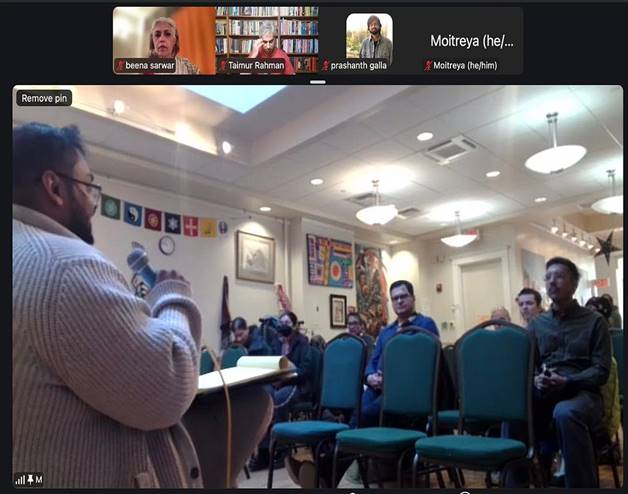
Screenshot of a BSAC volunteer seen introducing the event at the Community Church of Boston, Copley Square
He talked about the Progressive Writers’ Association, another organisation influenced by socialist politics. The PWA brought together luminaries like writers and poets Faiz Ahmed Faiz, Habib Jalib, Ahmed Faraz, and Ahmed Nadeem Qasmi who used essays and poetry to confront the horrors of partition and reflect social realities.
The publishing house Progressive Papers Limited owned by a landlord and politician Mian Iftikhar Uddin had almost the entire staff leaning to progressive leftist views. It published the biggest dailies of the time, The Pakistan Times and Imroze, both edited by Faiz. Both papers became platforms for these ideas to reach a wider public, noted Rahman.
Rahman also noted how trade unions held significant organisational powers at that time. The Pakistan Trade Union Federation controlled the railways, dockworkers, and textile factories. The railway workers’ union, which had come from India, had been part of the communist movement for decades there.
“If railway workers stopped, Pakistan could not function, because it was one of the key transport industries,” he said.
The student movement formed the third pillar of this expanding left ecosystem. The DSF was instrumental in expanding political consciousness and organising, which it did by organising around broader ideas, not propagating ideology as the film showed.
“It was one of the first great movements that really got students on a mass level involved in what is today Pakistan,” explained Rahman.
Unlike Aligarh-based student politics that predated independence, the DSF emerged organically within Pakistan. With no political party or agenda behind it, the movement mobilised students around everyday issues of college campuses.
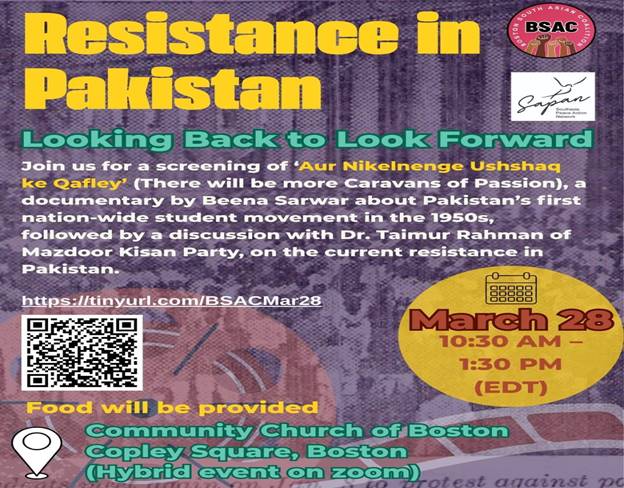
Poster by Boston South Asian Coalition for the event at Copley Square, Boston
The DSF’s influence resonated beyond West Pakistan to East Pakistan.
By the late 1960s and early 1970s, left-leaning ideology had moved to the center of the political and intellectual spectrums, as Rahman explained. Parties such as the National Awami Party, the Awami League, and the Pakistan Peoples Party articulated varying visions of progressive politics to win public support.
Pakistan’s 1970 general election, widely regarded as the country’s first and only free and fair polls , saw these progressive parties scoring major electoral victories, decisively trouncing right-wing candidates. But this moment proved short-lived.
The 1977 military coup by General Zia-ul-Haq dealt a serious blow to an otherwise vibrant left. Backed by international alliances and unfolding alongside global events such as the Iranian Revolution, the military regime implemented an ‘Islamisation’ project that crushed anything resembling creative and political expression.
“If you wanted to do theatre, you had to do it in backyards. If you wanted to make music, it was very difficult to find space to do all these things,” commented Rahman, describing how these restrictions changed the character of Pakistani society. “And if you wanted to do leftist political activity, which was almost impossible in the 1980s, you had to do it in a clandestine manner.”
Global isolation
The 1980s and 1990s saw the left weakened further by global geopolitical changes, including the collapse of the Soviet Union next door.
“We got cut off from leftist influences that we used to be in contact with – whether in Palestine, or Iran, or the Iraqi Communist Party, or the Indian Communist Party. The left in Afghanistan was bloodied and beaten and destroyed. The jihadi project completely won by the mid-90s,” noted Rahman.
At the same time, a generational gap began to emerge, with the older activists no longer present in the same capacity. The middle generation that Rahman terms a ‘skipped generation’ failed to consolidate the movement. Decades later, a new generation is engaged in further decolonisation, rediscovering history, and taking initiatives that connect to the larger cause.
Technology, Dr Rahman added, has played a crucial role in this revival. New organisations and movements, while not strictly Marxist or communist, are embracing left-leaning ideas and openly identifying with progressive causes, signaling a generational reinvention of modern cultural disruption in Pakistan.
This revival isn’t about recreating initiatives to keep on past legacies alive but to build on them for new realities. Dr Rahman cited examples such as the Mazdoor Kisan (Workers and Farmers) Party’s Salar Fayaz Khan, a 30-year-old politician from Hashtnagar, in Khyber Pakhtunkhwa, Pakistan, who used social media aggressively to mobilise his community, becoming Pakistan’s first openly ‘leftist’ mayor in 2021 after decades.
Feminist resistance
Global movements have also resonated locally. Rahman spoke of how echoes of the #MeToo movement were felt in Pakistan also, becoming the launchpad for the 2018 Aurat (Women’s) March in Karachi.
“Suddenly you saw thousands of young women come out into the streets,” Rahman recalled, “identifying with the left and then rediscovering what it was that their mothers had done, all the previous generation had done, which was all but forgotten.”
This rediscovery included how the country’s feminist struggle datesback to the day of independence, the 1960s teachers’ movement participated in by professors like Dr Sarwar’s wife Zakia Sarwar, the rise of the popular feminist movement Women’s Action Forum (WAF), and what ‘February 12’ meant , when the police baton charged a WAF protest in Lahore, 1983. There has been a rediscovery of the books written by feminist activists Farida Sher and Khawar Mumtaz and many others, said Dr Rahman, “and revisiting what Beena Sarwar was doing with War against Rape ,” starting a branch of a Karachi-based NGO in Lahore.
Dr Rahman also highlighted the courage of jailed activist-lawyer Imaan Mazari who has taken up causes once championed by figures like the late iconic lawyer Asma Jahangir, including defending human rights for Baloch communities and confronting extremism.
Mazari, he noted, played a pivotal role in taking down the “racket” of the “Blasphemy Business Gang,” which had trapped over 450 young people through false blasphemy accusations, putting them behind bars at the risk of death sentences. Mazari and her husband fought the cases in court and secured a court order mandating the government to set up an inquiry commission , exposing the gang across alternative and social media. The impact has been significant, with no mob violence reported in Pakistan over the past five months.
Rahman also pointed to recent shifts in the state’s response to extremist groups. These include the Tehreek e Labbaik Pakistan (TLP), which the government has repressed.
“People have gone to the government and said, ‘When are you going to wake up and protect the citizens of Pakistan from these crazy people?’ and the government used very heavy handed tactics [against TLP], which the Human Rights Commission of Pakistan has also correctly criticised , but the TLP now can’t be seen anywhere in public,” said Rahman.
He reminded the audience that change, however fleeting, builds cumulatively, and recalled how civil society activists helped topple another military dictator, Gen Pervez Musharraf, to restore democracy in the country.
“We created the pressure from below,” said Rahman.
The political parties joined hands to sign the Charter for Democracy, leading to the 18th Amendment to the Constitution, and to many women’s protection laws within Pakistan, countering “all the most horrible laws that were introduced in the period of Zia ul Haq, Eighth Amendment, Article 58-2B. the Law of Evidence,” he said, listing various repressive laws that Pakistanis have endured.
“These are victories we tend not to count enough,” he added, “but they show where the movement is heading.”
For some participants, the discussion offered a rare cross-border perspective.
“It was a very instructive morning in Boston, hearing about struggles in Pakistan. The documentary of brave students struggles in the 1950s connected the present day struggles for an equitable society. The room was filled with revolutionary optimism,” Padma B., a healthcare worker in Boston who helped organise the event, told Sapan News.
The bottom line was mostly that we don’t give ourselves enough credit for how far the country has come. We are always looking towards the future, the country we hope to become, while expressing all the rage we feel about the current events. It is so important to reckon with our past to know who we are today.
(Abdullah Zahid is a freelance reporter and Sapan News intern based in Karachi, passionate about covering peace, gender, human rights, and South Asia. He is part of the 2025 cohort of CNN Academy Fellows in the Voices From the South program.)
This is a Sapan News syndicated feature. https://www.sapannews.com .