
‘It Feels Like I Am Responsible for All the Problems’: Malala Discusses Pakistan, Palestine and Real Progress
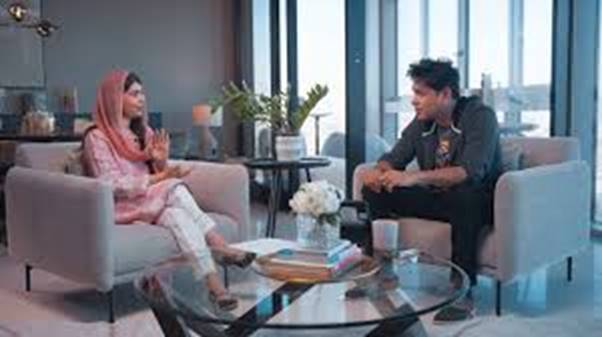
When two philanthropists working to promote education get together on a podcast, one can expect the conversation to focus on kids and getting them to school. When those philanthropists just happen to musician and educationalist Shehzad Roy sitting across from Nobel laureate Malala Yousafzai, there’s going to be a lot more to talk about.
The singer invited her on to the inaugural episode of his new podcast on Sunday and the tough questions began flying almost instantly.
The first question, of course, was on Yousafzai being a ‘foreign agent’ — a ‘fact’ any Pakistani uncle will attest to. She replied she wasn’t and told Roy dismissing good people as agents was an old habit for some. “We didn’t even spare Abdul Sattar Edhi,” she said.
The next question was about how her activism was portraying Pakistan negatively, to which she said her goal was the exact opposite of that.
“Wherever I go, I tell people. the terrorists aren’t the true representation of Pakistan. It’s their victims, those who were martyred, who sacrificed themselves, the ones who raise their voice against terrorism, they are the true representation of Pakistan,” she told the singer.
Malala spoke up about claims that she grabbed the first possible opportunity to flee Pakistan, saying, “I didn’t choose to leave my country.” She remembered how, when she was airlifted to the UK after being shot by the Taliban in her hometown in Swat, she was unconscious. “I just woke up one day and there were doctors around me speaking in English”.
She recalled being 15, scared, missing her parents and constantly asking doctors where they were and telling hospital staff she couldn’t pay for her treatment. “I find it funny that people think I planned all this. How could I have?” she asked.
Dawn Images
Roy compared the Nobel laureate to Swedish environmental activist Greta Thunberg, asking why her activism isn’t as loud and visible as the young Swede’s. Yousafzai called Thunberg a friend and asked why there had to be one right way to fight for a cause.
She brought up the different ways people fought for their rights during the Subcontinent’s fight for independence from the British, contrasting the civil disobedience of the Indian National Congress to the All India Muslim League’s more systematic methods, especially Quaid-i-Azam Mohammad Ali Jinnah’s approach of fighting from within the system. “We use whatever tools we have, whatever best suits our causes,” she said.
Next, the Nobel Peace Prize winner was asked about her silence on Palestine, to which she said she had been actively working on that issue since she was 16. She said she had donated the prize from one of her earlier advocacy awards — $50,000 for winning the World Children’s Prize — to schools in Palestine.
She said she condemned Israel’s genocide and reiterated the stance she has had since the brutal war on Gaza began — demanding a ceasefire, unrestricted flow of humanitarian aid and serious discussions about the future of the Palestinian people.
She denied taking a picture with former US Secretary of State Hillary Clinton and insisted the two were not collaborating despite being executive producers of a musical. She said the show’s creators had asked her to lend her voice to their project, which is something she’s happy to do for projects that have a positive impact in the world.
She said she even wore a pro-Palestine pin to the premiere of the musical, “but I think nobody wants that to go viral”.
Roy moved the discussion to Pakistan, asking why Yousafzai wasn’t as vocal about issues in her own country as she was about other places. She responded saying her focus was on girls’ education everywhere, but that she does feel strongly about minority rights in Pakistan especially.
She said women’s rights and protection were also important to her, bringing up the issue of women being arrested for political protests. She said she was especially concerned at the state of Pakistan’s democracy. “You see, I’ve seen a small segment of Pakistan’s political history, but I have seen three prime ministers changed, sacked, jailed. It upsets me that Pakistan’s democracy isn’t strong and Imran Khan is in jail. So, when the people of Pakistan stand up for justice and try to strengthen democracy, I am with them in that struggle.”
She said her own fight was to educate girls, but that needed a strong, democratic society, stability and peace.
Yousafzai talked about how people leapt at the chance to deride her for being even a second late to talk about something on the internet when her focus was on doing actual work and bringing about tangible change. “It feels like I am responsible for all the problems and only I can solve them. If I could do it, if I could stop wars, I’d spend every second speaking out and tweeting,” the Nobel laureate said.
She also briefed Roy on the work of the Malala Fund, which she said had so far invested Rs5 billion in the country, given largely to local organisations working on the ground to educate young girls.
In the past year, she said, the fund had given Rs95 million to organisations in Sindh and Gilgit-Baltistan, helping children study in flood-hit areas and covering costs such as transportation and school uniforms. In Khyber Pakhtunkhwa, the Malala Fund was providing free transportation to students in 10 districts in collaboration with local partners.
She told the host there were 13 million girls out of school in Pakistan, “we dream of a day that number is zero”. She insisted that change wouldn’t “come overnight, but there is incremental change and we’re making that happen”. -
Images
