
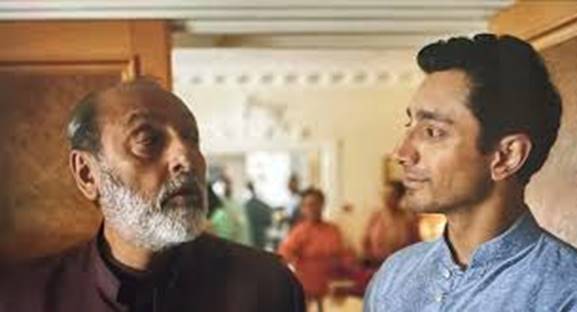
Sajid Hasan on Acting in Bait, Working with Riz Ahmed and a Story that Felt Personal
By Eefa Khalid
There was already a quiet kind of anticipation around Bait when the first promo dropped. Not loud, not overwhelming but enough to make you pause. Part of that curiosity came from seeing Riz Ahmed attached to the project, especially in a story that seemed to center a Pakistani family navigating life in migration, identity and culture changes. And then, almost unexpectedly, came the glimpse of Sajid Hasan , a familiar face in an unfamiliar space — which made the intrigue feel a little more personal.
It made you want to know more, not just about the story, but about how it would represent us.
Stories of diaspora are not new. Films like Monsoon Wedding and Bend It Like Beckham have explored South Asian identities abroad for decades. But Bait hinted at something less familiar: a story rooted specifically in Pakistani identity; its tensions, its emotional inheritances and its complicated relationship with migration.
Watching the series from Dubai, one moment in particular felt strikingly personal. A charged exchange between husband and wife where migration becomes a site of blame echoed a sentiment many quietly recognise. The line between choice and sacrifice blurs easily when distance and belonging are constantly negotiated. It is in these small, uncomfortable truths that Bait finds its emotional weight.
And it was this very weight and Hasan’s presence within it that led to this conversation.
Hasan has been a constant presence in Pakistan’s entertainment industry since the 80s, building a career that spans television, theatre, and film. He was the first Pakistani actor to appear in an Indian television drama — Tanha — and later in the international film A Mighty Heart. With Bait, Hasan once again becomes part of a global production; this time in a story that explores migration, identity and family through a contemporary lens.
But if Bait feels like a new chapter, Hasan is quick to frame it within a much longer journey, one shaped as much by creative passion as by frustration.
When asked about his early cross-border experiences, he traced his story back to a very different Pakistan. The early days of his career unfolded during the era of Gen Ziaul Haq, when creative expression existed alongside constraint. Yet, within those limits, there was also a thriving culture of theatre and collaboration.
He recalled working alongside some of the industry’s most influential figures, including writer Haseena Moin , whose work, he said, shaped generations. “We are all a product of her audiences,” he mused.
Those years, filled with experimentation and mentorship, stand in contrast to what is happening today, something he described as a gradual creative stagnation within mainstream television. Repetitive narratives, formula-driven storytelling, and a reluctance to take risks began to dominate.
“At one point, you give up,” he said plainly. “And I had given up, really.”
It is in this context that Bait became more than just another project.
The opportunity itself arrived unexpectedly. Initially approached to sign a non-disclosure agreement without much context, Hasan hesitated. It wasn’t until later, through a formal audition process, that things began to take shape. What followed was a Zoom call that took him by surprise: sitting on the other side was Riz Ahmed.
“I told him I was a big fan,” Hasan recalled. What began as a brief interaction turned into a second meeting, and shortly after, confirmation. Within days, he was on a flight to London.
There was a certain understated disbelief in the way he narrated the experience, but also clarity. At this stage in his career, he said, expectations are no longer the driving force. “You take everything in strides,” he noted.
What mattered more was the story itself.
For Hasan, Bait stood out because it centered a Pakistani family, not as a backdrop, but as the emotional core of the narrative. In a landscape where South Asian representation has often leaned heavily towards Indian stories, this felt significant.
“Indians have shown themselves so many times,” he said. “But this was finally a representation of a Pakistani family.”
It is a point he returned to more than once; that even a small role, within the right narrative, can feel meaningful not just personally, but collectively. For Hasan, being part of a story like this carried a sense of quiet validation. It wasn’t just another role; it was “a thinking representation of Pakistan,” something layered and reflective, in its own way.
He spoke with visible gratitude about the moment, but also towards the people who made it possible. Ahmed, in particular, remains central to that acknowledgment. Hasan credited him not just as a collaborator, but as someone who recognised where he could fit into the story. There was a warmth in the way he recalled their interaction. “I keep telling him,” he laughed, “I told him on the day, if you don’t keep me, God will punish you.”
That sense of ease, however, didn’t take away from the seriousness of the work itself especially when it came to building the emotional world of the series. Playing the father of Ahmed’s character meant stepping into a relationship that sits at the center of the narrative’s tensions. For Hasan, approaching that dynamic was less about overthinking and more about trusting the process.
Working with what he described as a deeply professional cast, the groundwork was laid early on through readings and long brainstorming sessions. Director Bassam Tariq, he noted, played an active role in shaping these interactions, even spending individual time with actors to understand their rhythm. There was, initially, a sense of unfamiliarity — new collaborators, new expectations — but it quickly gave way to something more organic.
Respect, Hasan said, became the defining factor. On a set where everyone understood their craft, hierarchy seemed to dissolve into collaboration. The rehearsals created a foundation, but the real work began once the cameras rolled. That shift from preparation to performance is something Hasan described as something akin to muscle memory. Years of repetition, of doing the work over and over again, suddenly finding purpose in a different space, for a different audience.
Yet, even within that structure, there was room to discover. Moments weren’t just performed; they were built in real time, shaped by instinct and interaction. When asked how one of the more charged scenes in the series that came towards the end of the show was rehearsed, he explained that that interestingly, when the script was given to all of them, it wasn’t part of it. Its eventual inclusion speaks to the fluidity of the process, to a set that allowed space for evolution.
That collaborative spirit extended beyond the immediate cast. Working alongside actors like Soni Razdan and Sheeba Chadda, Hasan found himself in an environment where learning never quite stopped. Their discipline, attention to detail and the way they approached each moment all added to the texture of the experience. Watching performers transform the instant a scene began, he said, felt like witnessing “magic”.
At the centre of it all was Ahmed, whose presence, Hasan observed, carried both focus and evolution. “He just keeps getting better with every take,” he said, likening the process to an athlete refining their form in real time.
Yet even as Bait opens a window to global collaboration, Hasan remained candid at times sharply critical about the limitations of Pakistan’s own industry.
From the decline of theatre to the lack of institutional support for artists, he outlined a system that, in his view, discourages experimentation. Gatekeeping, commercial pressure and a resistance to challenging narratives have all contributed to a narrowing creative space.
“Drama is about conflict,” he said. “But we are still deciding whether we’re allowed to talk about conflict.”
It is a struggle he has witnessed and endured over decades.
At the same time, he was refreshingly honest about the differences in working conditions. Comparing local and international productions, he didn’t hold back: the gap in facilities, in structure, in overall work culture is significant. His analogy of it being like a ride in a Rolls Royce versus a bike lands with a mix of humour and truth. “In Pakistan, you’ve got to be crazy to be acting,” he added, half-joking, half-serious.
There were moments of lightness too, though perhaps not as many as one might expect. Hasan laughed while recalling that on a set led by Ahmed, even laughter felt controlled. “Not with Riz,” he joked, “you never laugh too much,” before grounding it again in the discipline of the craft, the need to deliver, to meet the vision of the director, the writer, the producers.
Towards the end of the conversation, when asked if there was still a role he longed to play, Hasan gently moved away from the idea of chasing characters. What emerged instead was something more reflective, almost philosophical. He spoke about youth, about the state of the world, about the need for empathy in an increasingly fractured global landscape. Drawing from both poetry and lived experience, he returned to the idea of hope: the responsibility of younger generations to carve their own path and the urgency of choosing love and peace over division.
“We are all just visiting here,” he said, a line that lingers long after the conversation ends.
In many ways, that sentiment ties back to Bait itself; a story about movement, about temporary and permanent homes, about the spaces in between. And perhaps that is what makes Hasan’s presence in it feel so fitting. In an industry that is constantly shifting, he remains both a witness and a participant, carrying decades of experience into stories that are still trying to find their voice. - Images
