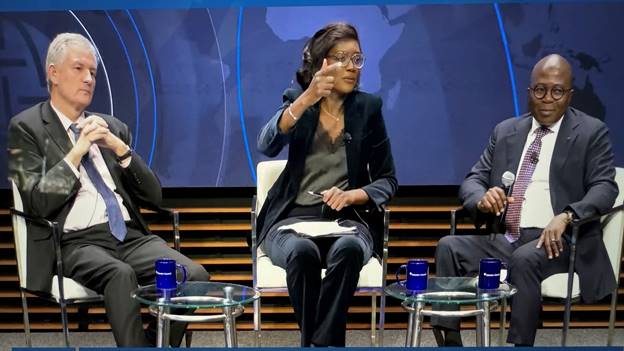
Left to right: Ambassador Laurent Bili, Rama Yade, Ambassador Ibrahima Touré
Sports Diplomacy Highlighted at Atlantic Council
By Elaine Pasquini

Washington, DC: The Atlantic Council’s Africa Center launched its Embassy Dialogue Series under the Power of Sports Program on March 10, 2026, moderated by Rama Yade, senior director of the Africa Center.
The upcoming 2026 FIFA World Cup being held in the United States, Mexico and Canada in June is not only about sports and the national identity and ambition of the participants, Yade told the online and in-person audience, but also partnerships between countries, such as the relationship between France and Côte d’Ivoire, as represented by her two guests, Ambassador Laurent Bili of France and Ambassador Ibrahima Touré of Côte d’Ivoire.
“Sports cannot be ignored anymore as a tool for diplomatic influence and for the investment sector,” Yade said. “The popularity of champions, their powerful voices, including in diplomacy and politics, the rising economic sector – everything leads to a recognition of sports diplomacy beyond the field.”
With a record 48 teams and 104 matches across 16 host cities in the three countries, this year’s tournament will be the largest in history capturing global attention.
Opening the discussion, Ambassador Bili recalled his first World Cup experience in 1998 when France won the title, noting “it was a moment of such national unity, pride and joy which was amazing.” Since then, in his various postings, he has been trying to take advantage of moments like that to have gatherings around the game in a friendly manner. “I plan to do the same this year in the US and build a bond with the host country,” he said.
“When we speak about sports, sometimes we underestimate the range of activities that are addressed when events are held in your country,” Bili said, reflecting on the Summer Olympics the French hosted in 2024. “It goes from feeding thousands of people, to connecting them, making them secure, building installations, ticketing, and in all of that we have developed a lot of experience.”
While many people question the amount of money countries spend on hosting sporting events, Bili called it “an occasion to invest in infrastructure,” which they did in some of the Paris neighborhoods. Existing sports facilities were upgraded, and fewer new ones were created. Some of the facilities function now for the local population, he said, noting events were held in Marseilles and other regions of France, not just in Paris. “I think it was one of the most cost-effective investments we have done in recent years.”
Asked about the place, if any, of politics in sports, he said he understood the idea that sports should be immune to world events, such as Russia’s invasion of Ukraine, “but sometimes it’s difficult to be out of it.”
Ambassador Touré said he has wonderful memories of all three World Cup tournaments in which his country participated, especially 2006 when it helped unite the country at a time when they were experiencing many crises.
Upbeat about the games which begin in June, the ambassador expressed pride in his country’s players. “We have what it takes. We have a young generation we are building up and we’re sure we have what it takes today – talent and everything – to go very far and even win the World Cup!”
Côte d’Ivoire should seize the opportunity of participating in the World Cup “because they can be the future of Ivorian sports,” he stated. “There is an opportunity for us to strengthen state-to-state sports cooperation, but also universities-to-universities cooperation because the United States has expertise in developing sports in universities.”
His country wants to use sports as a way to force the development of education infrastructure. “There is a whole ecosystem of sport now,” he stressed. “It goes from training our coaches, sports medicine, physiotherapists and what we call sports industry – you’re talking about the media, infrastructure managers, tourism, event organizers. We rely on not only our national capabilities but also on the international expertise to help us develop those layers of our national sports policy.”
On the subject of political crises being inserted into the games, he maintained that sports should “mainly be about entertainment, unity and brotherhood.”
The national moto of Côte d’Ivoire, he pointed out, is “We are the friend of everyone and the enemy of no one,” which is also reflected in their sports. “That is why you can see whenever we organize or take part in a sporting event beyond our border the type of spirit we bring in, putting an emphasis on the fans’ side of sports, the unity side of sports. That’s what I think sports should be about.”
(Elaine Pasquini is a freelance journalist. Her reports appear in the Washington Report on Middle East Affairs and Nuze.Ink.)