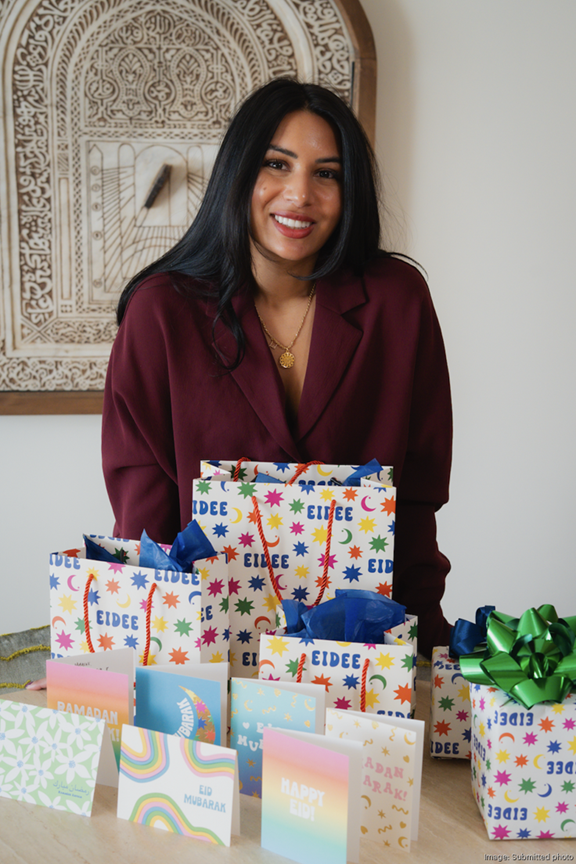
Sana Raheem, founder, The Ramadan Edit
How Sana Raheem Is Building the ‘Muslim Hallmark’ with The Ramadan Edit
By Cindy Barth
When Sana Raheem helped scale The Farmer’s Dog into a multibillion-dollar brand, she saw firsthand how powerful consumer products can be when they meet an overlooked need.
That experience also sharpened her eye for untapped markets.
Later, while celebrating Ramadan with her own family, Raheem realized Muslim consumers lacked something many other holidays enjoy: modern, design-forward products for gifting, hosting and decorating during the holy month.
That insight led Raheem to launch The Ramadan Edit , a brand creating elevated greeting cards, jewelry, gift wrap, décor and hosting essentials for Ramadan and Eid.
While retailers have long invested in holidays such as Christmas, Hanukkah, Diwali and Lunar New Year, Ramadan — observed by nearly 2 billion people worldwide — has remained largely underserved in Western retail.
“Ramadan represents far more than a single holiday,” Raheem said. “For many families, it’s a 30-day season filled with nightly gatherings, hosting and gift exchanges culminating in Eid.”
Now a New York City-based founder and working mother, Raheem is building a brand to meet that demand. The Ramadan Edit’s products — most priced under $100 — are carried by national retailers including HomeGoods and Michaels, as well as select boutiques and bookstores, and sold directly online.
Bizwomen spoke with Raheem about spotting an untapped retail opportunity, bringing modern design to Ramadan traditions and building what she calls the “Muslim Hallmark.”
What inspired you to launch The Ramadan Edit?
I’ve known since I was a young girl that Muslim families weren’t represented in retail.
Growing up in the Midwest, I loved walking through stores like Target or Michaels during the holidays. There were beautiful displays, wrapping paper and decorations everywhere. It felt joyful and celebratory.
But I never saw anything like that for Ramadan.
As I got older, I started asking why there wasn’t a brand that celebrated this moment the same way, something vibrant, joyful and reflective of how Muslim families live today. Ramadan is about gratitude and giving back, but it’s also deeply communal. Families gather nightly, host dinners and exchange gifts.
Yet most products in the market felt traditional or generic — dark blues, gold lanterns, designs that didn’t really capture the joy of the season. I wanted to create something modern, colorful and exciting for families today.
Why do you believe Ramadan has been overlooked as a retail opportunity?
There’s still a misunderstanding about what Ramadan represents.
Many people think of it simply as fasting, but it’s really a 30-day season filled with gatherings, nightly meals, gift exchanges and community events. Every evening can feel like a celebration.
Retailers sometimes underestimate the scale of that opportunity. I recently had a retailer say they weren’t sure they’d stock Ramadan cards because the window felt too short. I explained that Ramadan lasts an entire month. It’s essentially a full retail season.
At the same time, the Muslim consumer base in the US is young and growing. About 60% of Muslims here are under 40, and many are highly educated young families.
Globally, Muslim consumer spending is estimated in the hundreds of billions, but the retail industry hasn’t fully recognized it yet. When retailers do carry these products, they sell extremely well. Shelves empty quickly because people have been waiting for products that reflect their lives.
Did your experience helping build The Farmer’s Dog shape how you approached this business?
Absolutely. I joined The Farmer’s Dog in its early stages when it was just a small team and a big idea. At the time, fresh, human-grade pet food wasn’t taken seriously. Manufacturers didn’t want to work with us, and many people thought the concept was unrealistic.
But consumers told a different story. Customers would write saying their dogs had more energy or improved health after switching to fresh food. That made it clear we were solving a real problem.
The biggest lesson was if you truly understand the consumer and solve a meaningful problem, the business will find its way.
I’ve seen parallels building The Ramadan Edit. Early on, some doors didn’t open because people didn’t understand the concept or the market. But when the need is real, momentum eventually follows.
How have your own experiences shaped the products you’re creating?
I’ve always loved creativity — scrapbooking, crafts and anything that makes moments feel special.
When I looked at what existed for Ramadan, much of it felt static or traditional. Even online marketplaces had limited options, and mass retail offerings were often generic.
I wanted to create designs that feel joyful and expressive, things kids get excited about and families are proud to display.
One of the most rewarding moments is selling at events and seeing children run up to the table excitedly asking their parents if they can buy something. I never experienced that growing up during Ramadan, so seeing that joy now is incredibly meaningful.
What does the name “The Ramadan Edit” represent?
The name reflects a curated, modern approach.
Today, the brand focuses on gifting and stationery, but long term I envision The Ramadan Edit becoming a broader lifestyle platform, a place where people can discover thoughtfully curated products that celebrate Muslim culture and holidays.
The goal is that when people want meaningful gifts for Ramadan or Eid, they know exactly where to go.
Getting into national retailers can be difficult. What hurdles did you face?
One of the biggest hurdles was convincing people the market was large enough.
Many traditional stationery sales reps didn’t take the brand seriously, even with my background helping scale a billion-dollar company. They assumed the category was too small.
So I decided to do it myself. I started reaching out directly to buyers through cold calls and emails. Some didn’t respond, but eventually the right people understood the opportunity.
HomeGoods and Michaels were among the retailers that took a chance, and I’m incredibly grateful for that.
A lot of the process is simply proving the concept so retailers can see the demand firsthand.
What has surprised you most about the response?
The repeat customers. People come back again and again, which tells me the brand is resonating. I often hear parents say, “I’ve always wanted something like this for my children.”
That feedback is incredibly meaningful because it shows this wasn’t just a gap in retail. It was an emotional gap for families who wanted to celebrate in a more joyful way.
How has becoming a mother influenced the business?
I launched the company while pregnant last year, and my daughter is now seven months old.
Before scaling, I tested the concept by selling at fairs and small retail locations. That gave me direct feedback from customers.
After my daughter was born, I became even more focused. When your time becomes limited, you think carefully about what you want to build and why.
For me, it became about creating something meaningful not just for today’s families, but for future generations.
What impact do you hope the brand ultimately has?
I want to change how Muslims are represented in mainstream retail.
Ramadan and Eid shouldn’t feel like an afterthought on store shelves. My goal is to build a generational brand that celebrates Muslim culture authentically while also giving back.
A portion of every sale supports underserved Muslim communities through education initiatives. The vision is both commercial and community-driven by building something meaningful that also creates real impact.
Are you involved in designing the products?
Yes. I create mood boards and creative direction for the collections.
I work with an incredibly talented artist, Nadia Hassan, who helps bring those ideas to life. I discovered her work by flipping greeting cards over in stores to see who the artists were behind designs I loved.
I found one of her cards at Trader Joe’s in Florida, reached out to her and asked if she’d be interested in collaborating. She immediately understood the vision, and it’s been a wonderful partnership.
What advice has guided you most in your career?
Lean into your strengths.
Your biggest advantage is understanding what you do well and building around that. Then surround yourself with people who complement your skills, whether that’s employees, consultants or freelancers.
You can be very scrappy when building something new. The key is staying proactive and continuing to move things forward.
What might people be surprised to learn about you?
I’m very much an operator. I love building things and figuring out how to turn ideas into reality.
There’s real satisfaction in watching something start as an idea and grow into a tangible business. I also enjoy supporting other entrepreneurs because I know how hard it can be to take that first leap.
Any final thoughts for aspiring founders?
There’s a huge opportunity for entrepreneurs — especially those from underrepresented communities — to build brands that authentically reflect who they are.
It can feel risky, but if you believe deeply in the problem you’re solving, it’s worth taking the chance. Trying to build something meaningful is always better than wondering what might have been.
----------
The Ramadan Edit
Top official: Sana Raheem, founder
About: The Ramadan Edit offers elevated greeting cards, jewelry, gift wrap, décor and hosting essentials for Ramadan and Eid priced under $100 and is already carried by national retailers including HomeGoods and Michaels, stocked in select boutiques and bookstores, and sold direct-to-consumer via Shopify. - The Business Journals