Remembering Beloved Pakistani Hostel in London
By Dr Syed Amir
Bethesda, MD
For Pakistani students in England during the sixties, the Students' Hostel in London was a remarkable place of refuge. Situated in the Knightsbridge area, one of London’s most desirable neighborhoods, it hosted countless students drawn from all parts of Britain and Europe. The hostel, as far as I can determine, no longer exists, and it is unknown when its doors were shut down. Yet many of us who stayed there remember it fondly even after all these years.
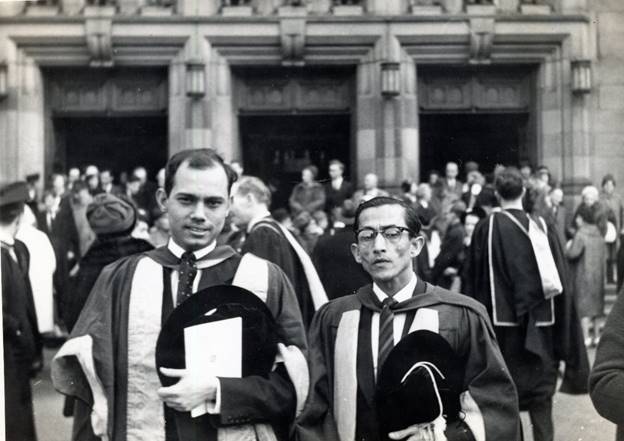
The writer (left) with Dr Ayub Bukhari (a friend, now deceased) after receiving the doctoral degree from Birmingham University
Habib Ibrahim Rehmat Ullah, a close associate of Quaid-i-Azam Muhammad Ali Jinnah and a passionate participant in the Pakistan movement, served as Pakistan’s first High Commissioner to the United Kingdom and established the High Commission in August 1947. It is not known when the High Commission sponsored the hostel, but it was one of the best moves to support the impoverished student community in England. The Hostel never served as a political base of any political party in Pakistan.
In the late nineteenth and early twentieth centuries, there were few Indian students in London, and most knew each other. They often came from wealthy and well-established families and, unlike their compatriots in India, were highly regarded in London. The status of Indian students in England went through various phases as relations between India and the ruling country changed over time.
The contrast in the financial situations of Indian students is illustrated by the stories of two prominent icons of the Indian independence movement. Mahatma Gandhi arrived in England as a student in September 1888 at age 19. His autobiography describes his early months in England as marked by homesickness and financial hardship. He had traveled across the ocean, defying his religious edicts, which angered his community.
At the time, the number of Indian students in London was small, and they usually stayed as guests in the house of some English landlady who helped guide them through
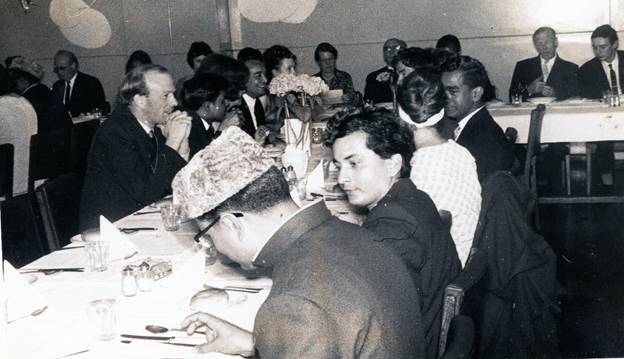
The Pakistan Day dinner at the University
the cultural and social norms of the new country. Gandhi, who lived on a very limited budget, rented a cheap one-room apartment, cooked his own meals, and kept his vows to his mother to avoid touching meat, women, and wine. On his own admission, a few times, he came close to breaking these pledges but never did.
Pandit Jawaharlal Nehru spent seven years studying in England and returned home in 1912, after attending the most expensive and elite schools -- Harrow and Cambridge. His father, Pandit Motilal Nehru, was a highly successful, wealthy lawyer and could afford to keep his only son in relative luxury in England. Jawaharlal Nehru adjusted to Western culture relatively quickly, and when he returned to India, he was thoroughly westernized, a veritable Englishman, for whom India was an unfamiliar country. Nehru, in a brief account of his Cambridge days, mentions being a member of the Association of Indians, known as the Majlis, which debated Indian politics without active involvement. He also mentioned a Center for Indian Students in London. Established by the India Office—a branch of the British government—it had its own character and was suspected of being a source of espionage for the Government.
By the time I arrived in England, it was a very different country from what it had been in the days of Mahatma Gandhi and Pandit Jawaharlal Nehru. A large number of South Asians had settled there, mostly workers who had come to meet the rising demand for labor in rapidly growing post-war British industries.
At the University of Birmingham, my alma mater, there were about 25 Pakistani students, drawn from both wings of the country, and a very active Pakistan Association, which often hosted social events. The president of the association was a highly regarded doctoral student in English, Dr Razia Khan, the daughter of the former speaker of the Pakistan National Assembly, Maulvi Tameez Uddin Khan. Another person who served as president was Dr Kaleem Ur Rehman, who later rose to become the head of the department and the dean of the faculty of arts at Karachi University.
I learned about the Pakistan Hostel soon after arriving at the university, through friends. During the Christmas holidays, the university was closed for a week, and in the summer, for a longer period. At Christmas, almost all English students went home to celebrate with their families. It was often a difficult time for foreign students, as the dining hall and cafeteria were both closed, leaving no suitable place to eat. For Pakistani students from various parts of Britain, London was a convenient place to spend the holidays.
I stayed at the Pakistan hostel several times during my student days at Birmingham University from 1960 to 1966. It offered safe, clean, and inexpensive accommodation, and felt like a piece of Pakistan away from home. As soon as I stepped inside, I felt at home, with familiar faces, the same spoken language, and the smell of spicy food. During my time, the hostel was managed by a kindly elderly Englishwoman. I remember she had snow-white hair and a gentle demeanor.
Almost always, I found her engaged in settling various disputes. Some students arrived without a valid reservation, or several showed up when the reservation was for only one person. These were days without computers, email, or smartphones. All records were on paper. Amazingly, the lady resolved all the tricky issues calmly and diplomatically without getting angry or upset. Normally, the two sleeping areas upstairs were designed for four beds each, but it was not uncommon to see twice that number occupying them. Occasionally, I saw people sleeping in beds in the corridors.
A special attraction was the Pakistani food, as the hostel had a cafeteria that offered reasonably good food, breakfast, lunch, and dinner. However, Christmas Day could be a problem, as the entire city was shut down, including the hostel’s cafeteria. Once, I remember, my friend Dr Khurshid Alam Khan, who later became the director of the Publications Division at the Pakistan Council of Scientific and Industrial Research, and I were wandering around Piccadilly Circus in search of food. We were hungry and tired and could not find any open dining facilities. Ultimately, we found a humble Café open, offering what they call a Wimpy bar; we now call it a hamburger. It tasted so delicious.
Every so often, you would meet people at the hostel you least expected. I once saw Sir Zafar Ullah Khan, Pakistan’s former foreign minister, resting on a couch in the hostel’s basement; perhaps he was unwell. On another occasion, after his dismissal from the cabinet by President Ayub Khan, for health reasons, Zulfiqar Ali Bhutto came to address the students and forcefully asserted that there was nothing wrong with him.
Ultimately, time moved, as it always does. The young students who visited the Pakistan Hostel went on to pursue different career paths. Although the hostel no longer exists, those of us still here continue to treasure the memories of the happy time we spent there.
(Dr Syed Amir is a former Assistant Professor, Harvard Medical School, and a health science administrator, US National Institutes of Health)