
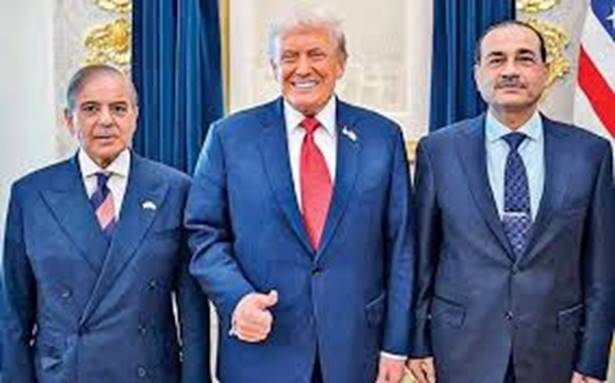
Pakistan has demonstrated something that no amount of skepticism can erase: that a nation with the right relationships, the right credibility, and the courage to act, can change the course of history – PhotoBOL News
How Pakistan Stopped the War, What Happens Next
By Arif Zaffar Mansuri
President, PL Publications
CA
On the evening of April 7, the world was staring into an abyss. United States President Donald Trump had issued a chilling ultimatum: Iran had until 8 PM Eastern Time to meet his demands, or face destruction on a civilizational scale. Markets were in freefall. Families across the Gulf were fleeing. And somewhere in Islamabad, two Pakistani leaders were working the phones with a quiet, urgent intensity that the world would not fully understand until it was over.
Less than two hours before that deadline, the guns went silent. And when President Trump explained why, he cited — by name — Prime Minister Shehbaz Sharif and Field Marshal Asim Munir of Pakistan.
That moment deserves to be understood in its full weight. The world held its breath that night, uncertain whether civilization itself would survive until morning. This was not a diplomatic footnote buried in the back pages of history. This was the headline — and Islamabad wrote it.
How Pakistan Did It
The story of Pakistan's mediation did not begin on April 7. It began weeks earlier, as Washington and Tehran exchanged missile strikes and the Strait of Hormuz, through which one-fifth of the world's oil supply passes, was effectively shut down. The economic consequences were staggering: five Gulf nations collectively stopped producing an estimated 7.5 million barrels of oil per day, a figure rising to 9.1 million barrels this month, according to the US Energy Information Administration. Gas prices in America were climbing toward $4.30 a gallon. Global stock markets were hemorrhaging value.
Into that vacuum stepped Pakistan. Foreign Minister Ishaq Dar coordinated with counterparts from Saudi Arabia, Turkey, and Egypt, then flew to Beijing for further consultations. China, Iran's largest trading partner, subsequently endorsed Pakistan's role, publicly supporting what it described as Islamabad's "unique and important" position in easing the crisis.
But the decisive moment came through the personal relationships that Field Marshal Munir and Prime Minister Sharif had carefully cultivated. Munir, who had visited the White House alongside Sharif in 2025 following the India-Pakistan conflict, had built what France described as a genuine personal rapport with President Trump. On Iran, Trump later told reporters, Pakistan knows the country "better than most." That trust became the only working telephone line between two nations that had long since stopped speaking and started shooting. According to reports from multiple outlets, including Bloomberg and TRT World, Field Marshal Munir served as the critical back channel, carrying sensitive messages between Washington and Tehran in the final, desperate hours. The turning point came shortly after 5 PM on April 7, when Trump held a direct call with Munir and determined that Pakistan's proposed two-week ceasefire framework was a viable path forward.
Trump's Truth Social post made history: "Based on conversations with Prime Minister Shehbaz Sharif and Field Marshal Asim Munir of Pakistan, and wherein they requested that I hold off the destructive force being sent tonight to Iran... I agree to suspend the bombing and attack of Iran for a period of two weeks."
Iranian Foreign Minister Abbas Araghchi responded with public gratitude to "my dear brothers, PM Sharif and Field Marshal Munir, for their tireless efforts to end the war in the region." Washington and Tehran, simultaneously, were crediting Islamabad. Pakistan's federal cabinet declared a National Day of Gratitude.
The Islamabad Talks — A Historic Responsibility
Prime Minister Sharif wasted no time. He announced that the United States and Iran had agreed to an "immediate ceasefire everywhere, including Lebanon and elsewhere," and personally invited both delegations to Islamabad on Friday, April 10, to "further negotiate for a conclusive agreement to settle all disputes."
What is already being called the "Islamabad Accord" framework represents the first direct, in-person negotiations between Washington and Tehran since the war began on February 28. According to Axios and The Hill, the US delegation will be led by Vice President JD Vance, alongside envoy Steve Witkoff and senior adviser Jared Kushner. Iran's delegation will be headed by parliamentary Speaker Mohammad Bagher Ghalibaf. The talks are based on Iran's 10-point proposal, which Trump described as "a workable basis on which to negotiate."
Bloomberg called Pakistan's achievement a demonstration of its "central role in global politics." The UK's High Commissioner to Pakistan, Jane Marriott, posted simply: "Thank you Pakistan for the quiet, effective, diplomatic role you have played in bringing about this vital ceasefire."
The Lebanon Problem
But there is a shadow hanging over this moment, and it has a name: Lebanon.
Within hours of the ceasefire announcement, Israel launched what its own military described as the largest coordinated strike of the current war, hitting more than 100 Hezbollah targets across Beirut, southern Lebanon, and the Bekaa Valley. Lebanese health authorities reported over 250 killed on Wednesday alone. The total death toll in Lebanon since the war expanded on March 2 now exceeds 1,530, with more than one million people displaced.
Prime Minister Netanyahu's office stated, in English only, notably not in Hebrew, that the ceasefire "does not include Lebanon," directly contradicting PM Sharif's announcement that the truce covers "everywhere, including Lebanon." The White House subsequently confirmed the American position aligns with Israel's.
Iran's IRGC responded with a stark warning: if attacks on Lebanon do not stop, Iran will resume hostilities. Reports emerged Wednesday that oil tankers in the Strait of Hormuz had again been halted. VP Vance himself described the overall situation as "a fragile truce."
The Lebanon contradiction is not a technicality. It is the fault line most likely to collapse the entire framework before Friday's talks even begin. Iran's original 10-point proposal explicitly demanded an end to hostilities in Lebanon. Trita Parsi of the Quincy Institute told Time magazine: "It's going to be very difficult for the Iranians to agree to a ceasefire on their own for themselves, while leaving Lebanon exposed."
What It Means
Pakistan is now positioned at the center of one of the most consequential diplomatic processes of the 21st century, carrying the hopes of a war-weary region and a globally rattled economy into a single room in Islamabad. The risks are real. The unresolved questions, uranium enrichment, Iran's ballistic missile program, US troop presence in the region, and Lebanon, are immense.
But Pakistan has already demonstrated something that no amount of skepticism can erase: that a nation with the right relationships, the right credibility, and the courage to act, can change the course of history.
Islamabad is ready. The world is watching. And Pakistan, once again, is answering the call.
(Arif Zaffar Mansuri is President of PL Publications, publisher of Pakistan Link and Urdu Link, and host of The Mansuri Show on ARY Digital TV. A veteran real estate investor, entrepreneur, industrialist, journalist, and community leader, he is dedicated to amplifying the voices of the Pakistani American community. Watch his show at YouTube.com/@MansuriShow or reach him at Salam@PakistanLink.com )