
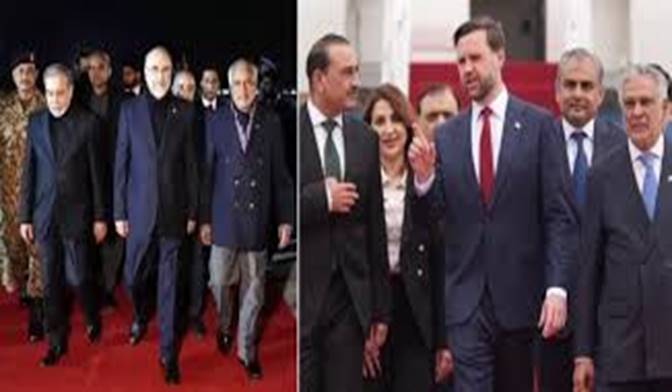
Pakistan’s current moment reflects both opportunity and constraint. Its geopolitical position ensures continued attention on the global stage, but its long-term trajectory will depend on domestic policy choices, institutional strength, and economic direction - Photo The Standard
Islamabad’s Diplomatic Role Opens Door to Economic Opportunity
By John Bosco
London, UK

Pakistan, and particularly its capital Islamabad, have long played a quiet but notable role in international diplomacy. Positioned at the crossroads of South Asia, the Middle East and Central Asia, the country has often acted as a facilitator of dialogue between rival powers. As Islamabad once again finds itself linked to sensitive international engagement between the United States and Iran amid a conflict that has continued for over a month, attention is returning to Pakistan’s broader strategic relevance.
Pakistan’s diplomatic history includes one of the most significant behind-the-scene roles in modern geopolitics. In the early 1970s, it helped facilitate contact between the United States and China at a time when both countries had no formal relations. Pakistan maintained ties with both sides and provided a discreet channel for communication. A key moment came in 1971 when US National Security Adviser Henry Kissinger travelled covertly to Beijing via Islamabad. This was followed by President Richard Nixon’s visit to China in 1972, which led to the normalisation of relations between the two countries and contributed to a major shift in Cold War dynamics.
This legacy continues to shape perceptions of Islamabad as a potential intermediary in periods of international tension. Pakistan has maintained working relations with a range of regional and global actors, which has occasionally allowed it to support indirect communication between states that do not engage directly. While such efforts are often informal and behind the scenes, they are viewed as part of Pakistan’s broader diplomatic utility.
In the current context, Islamabad is being viewed in some diplomatic circles as a possible venue for facilitating contact between Washington and Tehran. The discussions, still in early stages, reflect wider international concern over regional stability. Pakistan’s role, as in previous instances, is understood more as an enabling one rather than as a principal negotiator.
At the same time, analysts say Pakistan’s international positioning is closely linked to its internal economic direction and governance choices.
Across the wider Muslim world, countries differ significantly in their economic strength, governance models and resource endowments. Many Islamic countries are resource rich, particularly in oil and gas, and have developed stronger fiscal positions as a result. Pakistan, by contrast, does not benefit from comparable natural resource wealth. This has contributed to an ongoing domestic debate about economic competitiveness and national direction, including questions around governance efficiency, productivity and long-term development strategy.
Not all Muslim majority countries rely on natural resources, yet several have achieved relatively stronger economic performance through diversification, institutional reform and openness to global markets. This comparison has prompted further debate within Pakistan about how it can adjust its economic mindset, improve competitiveness and better integrate into the global economy.
Within this context, there is also discussion about the need for a shift in mindset towards greater openness, pluralism and economic inclusion. Some analysts argue that improving access to opportunity, strengthening institutional transparency and encouraging wider participation in economic activity could help improve internal stability and international confidence in Pakistan’s economy.
Pakistan remains the only nuclear armed state in the Muslim world. Alongside this, it maintains one of the largest standing armed forces in the region, which officials say contributes to regional deterrence and national security stability. These capabilities are often cited as key elements of Pakistan’s strategic profile.
At the same time, questions are sometimes raised about the level of diplomatic support Pakistan receives from other Muslim majority countries on issues of shared concern, including Kashmir. While Pakistan continues to advocate for such issues on international platforms, responses from the wider Muslim world have often been shaped by broader geopolitical and economic interests rather than uniform political alignment.
Pakistan has historically positioned itself as an advocate for issues affecting the wider Muslim world. However, policymakers and analysts increasingly point to the need to balance this external diplomatic engagement with stronger domestic priorities. These include economic reform, institutional strengthening, improved governance and social development.
Economic reform is widely seen as central to Pakistan’s ability to benefit from its current diplomatic visibility. Attracting foreign direct investment remains a priority, particularly in sectors such as energy, infrastructure, manufacturing and technology. There is also increasing focus on encouraging domestic investors and members of the Pakistani diaspora to reinvest capital that has previously moved abroad. Analysts note that this will depend on policy consistency, regulatory clarity and long-term economic planning.
Security remains another key factor in shaping investor confidence. A stable and predictable internal environment is widely regarded as essential for sustained economic growth. Strengthening law enforcement, ensuring protection for investment projects and maintaining broader stability are seen as necessary steps in improving Pakistan’s economic outlook.
Infrastructure development is also critical. Expanding transport networks, improving energy reliability and modernising urban systems are frequently highlighted as areas requiring continued investment. Pakistan’s geographic location offers potential advantages as a regional trade and transit hub, but realising this potential depends on sustained improvements in connectivity and logistics.
For now, Islamabad’s position reflects a combination of historical legacy and current geopolitical relevance. As global tensions continue to evolve, Pakistan remains one of several countries able to provide indirect channels of communication between rival states. This role, while important, is largely limited to facilitation rather than decision making. However, it places Pakistan in a position of continued diplomatic relevance at a time when such intermediary roles are increasingly valuable.
It is widely argued that Pakistan is now in a position to make greater use of this diplomatic visibility. The extent to which this translates into meaningful economic benefit will depend on how effectively the country aligns its external engagement with internal reform. Pakistan’s current moment reflects both opportunity and constraint. Its geopolitical position ensures continued attention on the global stage, but its long-term trajectory will depend on domestic policy choices, institutional strength and economic direction. If these elements are aligned, Pakistan’s diplomatic role is increasingly seen in a positive light across the international community, reinforcing its image as a constructive and credible participant in global affairs. - bosco_jj@yahoo.com
