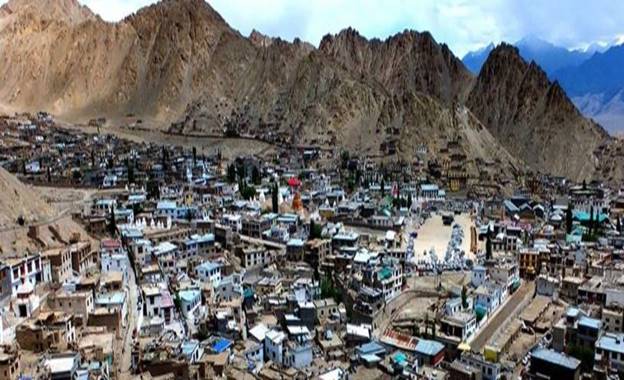
On International Women’s Day, a reminder to focus on people, not politics. Placing gender equality and women’s empowerment at the heart of peace and development efforts between India and Pakistan offers a radically different way to rethink Indo-Pak relations. Above: A view of Leh in Ladakh, highlighting the role of women’s empowerment in advancing peace in border regions - Photo Dr Feroza Sanjana
‘Gender Diplomacy’: A New Peace Project for India‑Pakistan and South Asia
By Dr Feroza Sanjana

The foreign policy discourse on India-Pakistan relations is centered around traditional security narratives, tired tropes of military posturing, border skirmishes, and nuclear deterrence, with little to no airtime given to the critical importance of human security.
The emphasis on militarization distracts from how deeply conflict disrupts the average citizen’s life. Since last year, Pahalgam alone has lost jobs in tourism, affecting hotels, tour operators, and small businesses. Before its suspension in 2019, cross-LoC trade between India and Pakistan in Jammu & Kashmir supported jobs for over 20,000 people including truck drivers, labourers, restaurant owners, gas station employees, and repairmen.
In the coming decades, two interwoven crises loom large in India and Pakistan: the large numbers of young people struggling to find work and deep-rooted gender inequality. Millions of young people in both countries enter the job market each year with severely mismatched skills.
In India, nearly a third of young people, many of whom are women, are not in employment, education, or training. There are similar figures in Pakistan.
This is against a backdrop where Delhi and Islamabad already see concerningly low female labour force participation rates, which are some of the lowest in the world.
Any attempt at lasting peace between India and Pakistan needs to go beyond militarised responses and offer long-term solutions for its people.
Gender diplomacy offers a new vision for a South Asian peace project. Placing gender equality and women’s empowerment at the heart of peace and development efforts between India and Pakistan, it offers a radically different way to rethink Indo-Pak relations, focusing on people, not politics.
This approach has two pillars – economic co-operation by advancing cross-border trade among women’s enterprises to spur job creation; and empowering women as leaders in communities affected by conflict. As I have argued in a book chapter, Women’s Entrepreneurship and the Start-Up Ecosystem in India , “There is an urgent need to support women in both business and public life for any economy to truly thrive.”
Women-led initiatives
Women in both India and Pakistan remain severely underrepresented in decision-making roles in government. In the workforce, they face discrimination, restricted to low-paid, informal jobs. They spend a disproportionate amount of time on unpaid care work compared to men, much like other countries in South Asia, further limiting their opportunities.
On both sides of the border, women entrepreneurs are operating in textiles, handicrafts, and agriculture. These Micro, Small and Medium Enterprises (MSMEs) can benefit from each other’s know-how and explore new markets. Multi‑lingual, women‑led digital trade platforms can connect women‑owned MSMEs across both countries. These can be well linked to national entrepreneurship schemes and offer simplified payment gateways to allow their businesses to grow, connecting them to South Asian and international markets. As business interests on both sides become more entrenched, those with influence will have stronger incentives to protect their investments.
Aside from digital platforms for women-owned businesses, another concrete example could be to foster women-led marketplaces. Located along the borders between the two countries, these could be designed to be safe, offering clean facilities and childcare. Stable and lower-cost customs and visa processes could help restore trade relations and the trust of local communities affected by conflict.
In states such as the two Punjabs, or Gujarat-Sindh, resuming cross‑border trade could restore thousands of livelihoods, especially in logistics, manufacturing, and support services that have been strongly hit by trade restrictions.
Of course, the continued risk of disruption due to security threats or terror attacks will need to be mitigated. This is precisely why the second pillar of gender diplomacy, namely, women-led initiatives for preventing violent extremism will be essential.
Women are often the first to detect signs of radicalization within families or communities, from changes in ideology, behaviour, or social circles. Here, women can be empowered as leaders of peacebuilding efforts, in offering psychosocial support to the community and as trainers offering vocational skills to young people.
The benefits are clear. Estimates suggest that taking measures to close the gender gap in labour force participation could increase South Asia’s GDP by up to 51%. Countries with greater gender equality are also less likely to resort to military force in international disputes and correlate with a lower risk of political violence and internal conflict.
Real-life examples in the region already exist – the ‘Culture and Conflict’ initiative runs projects across various countries in South Asia supporting the economic empowerment of women artisans and textile workers as a key pathway to peacebuilding in conflict-affected communities.
Rethinking Indo-Pak relations
In the next decade, India and Pakistan are at a grave risk of squandering their precious demographic dividend. Shifting the narrative is urgent and will require significant political vision and leadership on both sides. A quick web-scrape sample of over 1,400 Twitter posts on India-Pakistan relations over the last year since the Pahalgam attack throws up precisely two posts – which emphasize the need to go beyond narratives of counterterrorism and, instead, focus on a more community-centric approach to long-term peace.
Similarly, over the last decade, discussions in the Indian Parliament on India-Pakistan relations have centered narrowly around border security, border fencing, securing maritime borders, counter-terrorism measures for targeting and capturing suspected terrorists, as well as the past imprisonment of Indian fishermen in Pakistan. Parliamentary discussions on Indo-Pak collaboration, too, are restricted to the Kartarpur Corridor, considerations for academic exchanges, closely matched with debate discussions on cricket.
Gender diplomacy does not treat women or gender as an add‑on; it seeks to make women central actors in a new architecture of peace. Placing women’s economic empowerment and leadership at the center of Indo-Pak bilateral engagement can offer a viable path for regional stability.
This approach offers a 21st-century-ready vision for reviving Indo-Pak relations. Measured not by military stand-offs and loss of more lives, but rather by empowering women, it offers a pathway for building a generation of voters with improved livelihoods, strengthened communities, and fostering a stable South Asia.
(Dr Feroza Sanjana is a political scientist and development practitioner who has been an expert advisor on South Asian politics to the European Union. She was a Visiting Professor in Political Science at Freie University Berlin and a Doctoral Fellow at Stanford University, California. She has a PhD in Political Science from the Berlin Graduate School for Transnational Studies.)
https://www.sapannews.com .